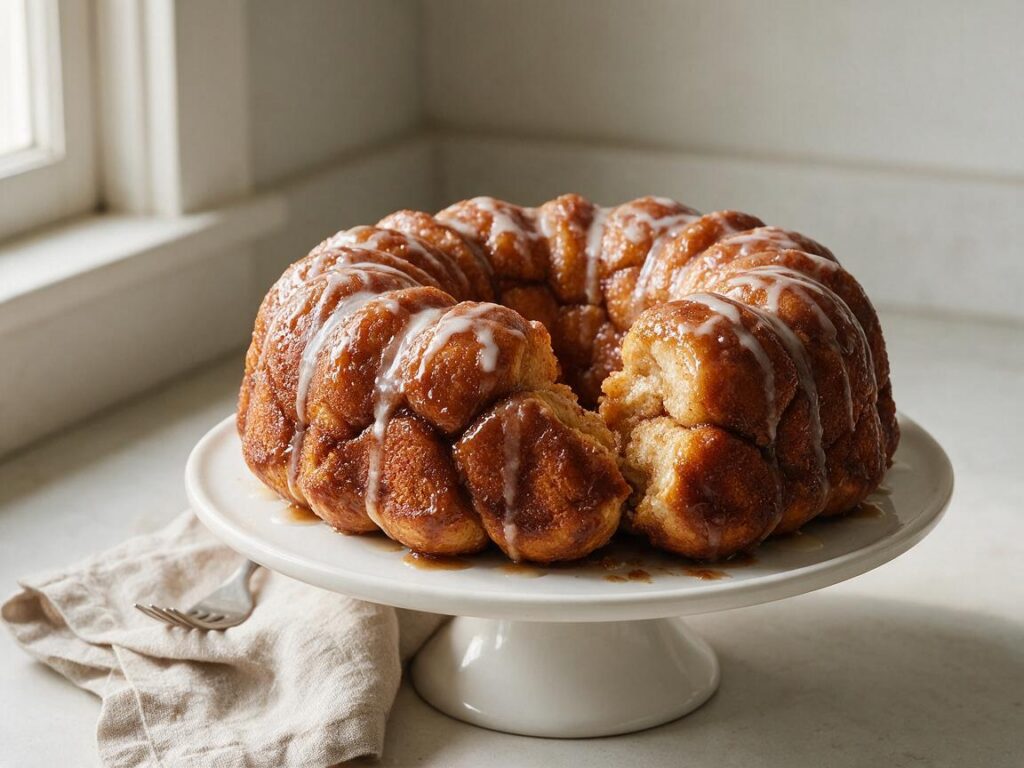
Homemade monkey bread is a pull-apart pastry made from balls of dough coated in butter and cinnamon sugar, packed into a Bundt pan, drenched in a brown sugar syrup, and baked until the syrup caramelizes into a gooey glaze. The sources behind this guide show that the dish can be made with a from-scratch yeasted dough, canned biscuit dough, frozen dinner rolls, or even a no-yeast baking-powder dough, and that the choice mostly comes down to how much time you have. This article explains what the dish is, how the dough options differ, what each ingredient does, how to assemble and bake it, how to judge doneness, and how to store or troubleshoot it. It is a planning and source guide, not a single tested recipe, so quantities and times are attributed to the recipes that published them.
Understanding Homemade Monkey Bread
Homemade monkey bread is a tear-and-share pastry built from small pieces of dough that are coated, stacked in a tube or Bundt pan, and baked under a brown sugar syrup. As the loaf bakes, the syrup caramelizes and coats each piece, so the finished bread pulls apart by hand into soft, sticky bites. Serious Eats describes the result as pillowy-soft and satisfyingly sticky, and notes the pastry also goes by names such as pinch me cake, bubble loaf, sticky bread, pull-apart cake, plucking cake, and monkey brains.
The dish has a documented lineage. Serious Eats traces it to aranygaluska, a Hungarian round pull-apart cake of dough balls rolled in walnuts and sugar that immigrants brought to America in the 19th century. Betty Crocker's Picture Cookbook included a related "Hungarian Coffee Cake" in 1950, made with yeast-raised dough coated in melted butter, pecans, and cinnamon sugar. Monkey bread recipes then appeared in American women's magazines from the 1950s onward, and Nancy Reagan popularized it further by serving it at White House Christmas parties in the 1980s.
The core structure stays constant across sources: portioned dough, a butter-and-cinnamon-sugar coating, a brown sugar or caramel syrup, and a Bundt-style pan. What changes is the dough. A from-scratch yeasted dough rises twice and takes roughly three hours from flour to plate, while canned biscuits skip rising entirely and can go from can to oven in ten or fifteen minutes. Frozen dinner rolls sit between the two, and a baking-powder dough needs no rise at all. If you enjoy planning make-ahead breakfast baking, the same time-first thinking applies to easy banana bread, where a quick bread replaces the yeast dough entirely.
Tips
- Decide first whether you want a from-scratch yeasted loaf or a shortcut dough; that choice sets the whole timeline.
- In the syrup-based recipes cited here, the brown sugar syrup is what makes the bread gooey, so follow the source recipe's quantities rather than reducing them.
- A Bundt or tube pan is traditional, but 9×13-inch dishes, loaf pans, muffin tins, slow cookers, and air fryer pans all appear in the sources.
Choosing Your Dough for Homemade Monkey Bread: Yeast, Biscuit, or Alternative
The dough decision is the biggest fork in the road. Serious Eats describes an enriched yeasted dough as producing a moist, fluffy texture similar to milk bread or brioche, and argues that ready-made biscuit dough is "rather biscuit-like" rather than pillowy. Sally's Baking Addiction uses a milk-and-butter enriched dough with 5 cups of all-purpose flour, 2 large eggs, and 2 1/4 teaspoons of yeast, with a total time of 3 hours and 20 minutes. The trade-off is time: the dough rises once in the bowl for 1 to 2 hours, then the shaped pan rests 20 minutes before baking.
Canned biscuit dough is the fastest route. Allrecipes' Best Monkey Bread uses 3 (12-ounce) packages of refrigerated biscuit dough with a 10-minute prep and 40-minute bake. Pillsbury's version uses 2 cans of Grands! Flaky Layers biscuits, cuts each biscuit into quarters, and bakes 30 to 40 minutes. Life Love and Sugar uses 2 cans of biscuit dough with a 30-minute prep and 45-minute bake. These recipes skip kneading and rising, so the work is mostly cutting, coating, and arranging.
Frozen dinner rolls are a third option: the source roundup describes five minutes of work the night before, with the rolls rising on the counter while you sleep. Canned cinnamon rolls bring their own cinnamon and icing. A no-yeast baking-powder dough needs no rise at all, and a sourdough version appears in the roundup with a maple caramel. Gluten-free and vegan versions also exist, though the gluten-free dough is described as looking more like thick cookie dough than bread dough. If you are weighing a yeast dough against a quicker batter-style bake, the same trade-off shows up in easy banana bread, where a quick bread replaces the yeast dough entirely.
Tips
- Choose yeasted dough for the softest, most bread-like crumb and accept the 2- to 3-hour timeline.
- Choose canned biscuits when you want monkey bread in about an hour with minimal hands-on work.
- Frozen rolls suit overnight planning; canned cinnamon rolls and baking-powder dough are other shortcuts named in the sources.
Key Ingredients and Their Roles in Homemade Monkey Bread
In a from-scratch dough, milk, butter, and eggs are the enrichment. Serious Eats explains that the fat from eggs and butter coats the gluten proteins glutenin and gliadin, limiting gluten formation; too much gluten makes monkey bread tough and chewy, while the dairy keeps it buttery and tender. Sally's Baking Addiction warms 1 1/2 cups of whole milk to about 110°F (43°C) for the yeast, and uses 1/3 cup of melted butter in the dough plus more for coating and the syrup. Salt and sugar season the dough and feed the yeast.
Yeast is the leavener in the from-scratch versions. Sally's Baking Addiction uses 2 1/4 teaspoons of Platinum Yeast from Red Star, while Allrecipes' from-scratch version uses 2 1/2 teaspoons of active dry yeast proofed in warm water with a teaspoon of sugar until bubbly and foamy, about 5 minutes. Humbly Homemade warms 1 1/4 cups of milk to 98°F to 105°F and lets the yeast mixture sit 10 minutes until frothy.
The coating is granulated sugar plus ground cinnamon, and the syrup is melted butter, brown sugar, and often vanilla. Sally's Baking Addiction uses 1 1/4 cups granulated sugar with 1 Tablespoon cinnamon for coating, then 2/3 cup brown sugar with 1/4 cup butter and 1 teaspoon vanilla for the syrup. Serious Eats notes that brown sugar gives the syrup deep molasses notes and that light or dark brown sugar both work. It also warns not to boil or cook the syrup for an extended period, because the sugar can crystallize and turn grainy. Optional add-ins named across sources include chopped walnuts, pecans, raisins, dried cranberries, and chocolate chips.
Materials
- Whole milk or milk of choice, warmed for the yeast
- Yeast (instant or active dry) for from-scratch dough
- Granulated sugar for the dough and the cinnamon-sugar coating
- Ground cinnamon for the coating
- Brown sugar for the syrup
- Unsalted or salted butter, melted, for the dough, coating, and syrup
- Eggs for enriched from-scratch dough
- All-purpose or bread flour
- Salt
- Vanilla extract for the syrup or icing
- Confectioners' sugar and milk for an optional icing
- Optional add-ins: walnuts, pecans, raisins, dried cranberries, chocolate chips
Tips
- Use an instant-read thermometer for the milk or water; the sources give recipe-specific yeast temperatures such as 110°F (43°C), 98°F to 105°F, and 120°F to 130°F, and the right range depends on the yeast type and method.
- Do not boil the brown sugar syrup for long, or it can crystallize and become grainy.
- If you coat dough balls in cinnamon sugar, separate some coating into a smaller dish so the main bowl does not clump from butter and moisture.
Step-by-Step Assembly and Baking for Homemade Monkey Bread
The assembly sequence below describes a typical yeasted approach; shortcut doughs such as canned biscuits, frozen rolls, and no-yeast baking-powder dough follow different handling and timing. First, make or portion the dough. For a from-scratch yeasted dough, mix and knead until the dough is soft and slightly tacky, then let it rise until doubled. Sally's Baking Addiction suggests a windowpane test: stretch a golfball-size piece until light passes through without tearing. Serious Eats recommends rolling the dough into a rectangle and slicing it into six rows of eight for 48 portions, though eyeballing is fine.
Second, prepare the coating and the pan. Generously grease a 10- to 12-cup Bundt pan; Sally's Baking Addiction says nonstick spray is best for this recipe. Melt butter in one bowl and mix granulated sugar with cinnamon in another. Allrecipes' from-scratch version mixes 1 1/2 cups brown sugar with 1 1/2 teaspoons cinnamon for its coating, showing that coating formulas vary.
Third, coat and arrange. Roll dough into balls about 1.25 inches in diameter (Sally's Baking Addiction says you need 40 to 45 balls), dip each in melted butter, then roll in cinnamon sugar and place in the pan. Serious Eats advises not being stingy with butter and sugar, because the sugar helps glue the dough into its loaf shape and the butter keeps the pieces from adhering too firmly. If using nuts or raisins, arrange them among the pieces as you go.
Fourth, add the syrup and bake. Melt the remaining butter, whisk in brown sugar and vanilla, and pour evenly over the shaped bread. Serious Eats suggests tilting the pan or tapping it lightly so the syrup sinks into the nooks. Adjust the oven rack to a lower position and preheat to 350°F (177°C); Sally's Baking Addiction notes baking toward the bottom of the oven helps the top avoid burning. Bake 35 to 45 minutes, covering loosely with foil if the top browns too quickly. Cool 5 to 10 minutes, then invert onto a serving plate. If you like planning make-ahead breakfast baking, the same time-first thinking applies to easy banana bread, where a quick bread replaces the yeast dough entirely.
Steps
- Make or portion the dough; for yeasted dough, knead until soft and slightly tacky, then let it rise until doubled.
- Generously grease a 10- to 12-cup Bundt pan with butter or nonstick spray.
- Melt butter in one bowl and mix granulated sugar with cinnamon in another.
- Roll dough into balls about 1.25 inches in diameter, aiming for 40 to 45 balls.
- Dip each ball in melted butter, roll in cinnamon sugar, and arrange in the pan, adding nuts or raisins if using.
- Melt the remaining butter, whisk in brown sugar and vanilla, and pour evenly over the shaped bread.
- Adjust the oven rack to a lower position and preheat to 350°F (177°C).
- Bake 35 to 45 minutes, covering loosely with foil if the top browns too quickly.
- Cool 5 to 10 minutes, then invert onto a large serving plate or cake stand.
- Whisk icing ingredients if using and drizzle over the warm bread.
Tips
- For canned biscuit dough, cut each biscuit into quarters and shake pieces in a bag with cinnamon sugar.
- For a 9×13-inch pan, one source notes it bakes faster and more evenly than a Bundt pan.
- Set the pan on a baking tray if using a caramel sauce, to catch spillover in the oven.
Doneness and Internal Temperature
Visual cues and a thermometer both matter. Pillsbury says to bake 30 to 40 minutes, until the bread is golden brown and no longer doughy in the center, and suggests gently pulling apart a piece near the center with a fork; if it separates easily, the bread is fully baked. Sally's Baking Addiction bakes 35 to 45 minutes or until golden brown on top. Allrecipes' from-scratch version bakes about 35 minutes until golden brown.
Internal temperature gives a more reliable signal. King Arthur Baking says many of its yeast bread recipes call for a perfectly baked loaf to reach 190°F inside, according to the source roundup. The recipes in that roundup give their own figures: Red Star Yeast bakes its pumpkin monkey bread until the dough reads 185°F to 190°F, The Recipe Critic cooks its slow-cooker version until the center reaches 190°F, and Heartbeet Kitchen asks for at least 200°F inside its sourdough version. Humbly Homemade bakes 30 to 35 minutes until a kitchen thermometer reads at least 190°F in the middle. Hailee Recipes bakes 35 to 45 minutes until golden brown and the internal temp reaches 190°F.
Because the bread is a yeast dough, the same doneness logic that applies to other enriched breads applies here. If you want a broader reference point for internal temperatures in home baking, the guidance is consistent: a thermometer tells you more than the top. Cover loosely with foil if the top is browning too quickly, and remember that a Bundt pan's center is the last part to set.
Tips
- Use an instant-read thermometer inserted into the middle of the bread; the recipes in the source roundup give targets of 185°F to 200°F, with 190°F cited by several, but the target varies by dough and recipe.
- If the top is browning too quickly, cover loosely with foil and continue baking.
- A fork test near the center is a useful backup: the bread is done when a piece separates easily.
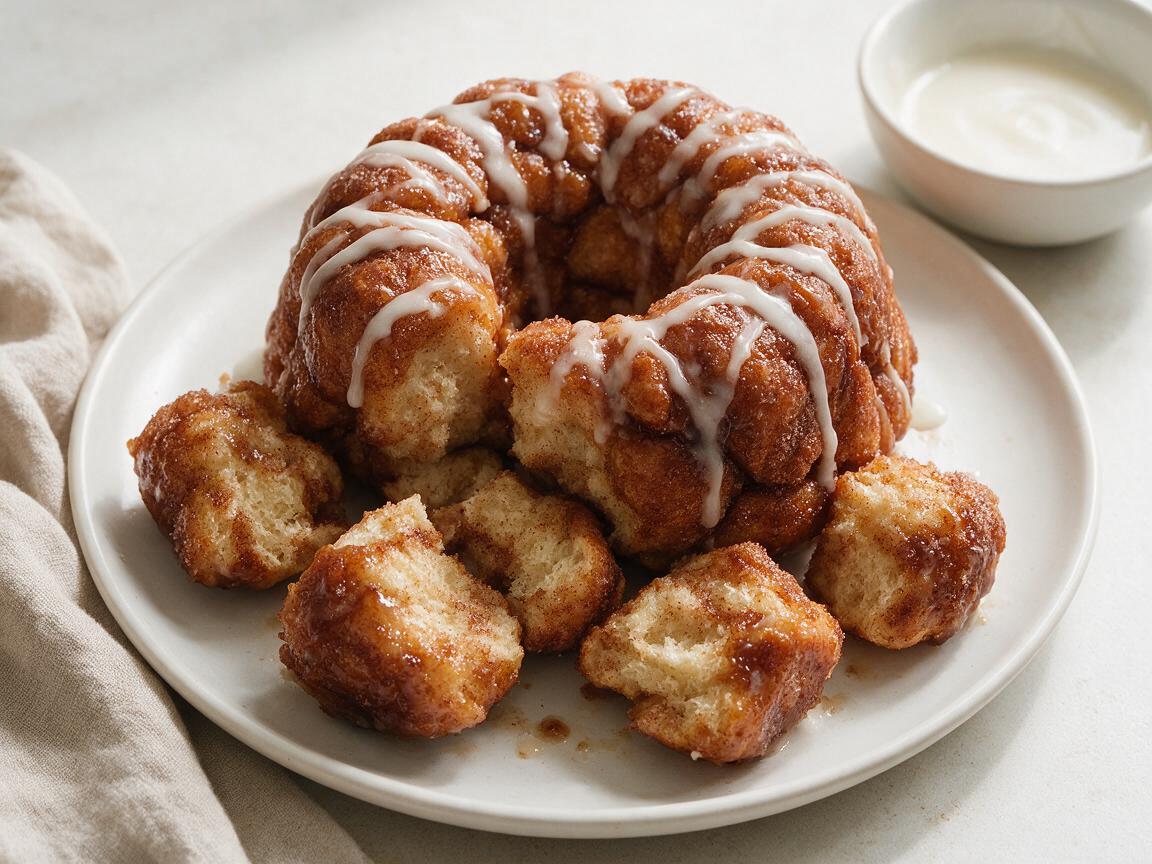
Make-Ahead and Storage Guidance for Homemade Monkey Bread
Monkey bread can be made ahead in several ways. The source roundup says most homemade doughs go into the fridge overnight, either assembled in the pan or as a risen dough, and bake in the morning after a rest on the counter. Jami Boys' adapted Cook's Illustrated recipe gives both routes: an hour's rise and a same-day bake, or half an hour on the counter, a night in the fridge, and out again two hours before serving. Julie Blanner's frozen-roll version rises uncovered on the counter overnight instead. The pizza version freezes unbaked and thaws in the fridge overnight.
Crazy for Crust says you can assemble the entire thing in the baking dish, cover with plastic wrap, refrigerate overnight, then take it out and place it near the oven while the oven preheats so it comes to room temperature. Sally's Baking Addiction notes monkey bread tastes best served the same day, and that leftovers should be covered tightly and stored at room temperature for 1 day and in the refrigerator for up to 4 days. Crazy for Crust says leftovers can sit on the counter for up to 2 days in an airtight container and can be reheated in the microwave or air fryer.
The source roundup summarizes storage across recipes: plain glazed monkey bread keeps one to four days at room temperature, depending on the recipe, and up to five in the fridge. Most pages freeze the baked bread, with windows from one to six months, and two of the pages glaze it after thawing rather than before. Cream cheese glazed and pizza versions belong in the refrigerator. Steam & Bake says its monkey bread is best eaten on the day of baking but can be gently reheated on the second day.
Tips
- For an overnight fridge rise, assemble the pan, cover it, and refrigerate; let it sit near the oven while preheating the next morning.
- Freeze baked monkey bread for one to six months, and glaze after thawing if the source recipe says to.
- Refrigerate cream cheese glazed and pizza versions rather than leaving them at room temperature.
Troubleshooting Common Homemade Monkey Bread Issues
Sticking is a common problem. Crazy for Crust says to spray the pan well with nonstick cooking spray or grease and flour it, and to remove the bread from the pan 10 minutes after removing it from the oven, because once it cools it is hard to remove. Pillsbury says to loosen the edges with a metal spatula, cool in the pan 5 minutes, then place a serving plate upside down over the pan and flip carefully with oven mitts. If the bread does not release, gently tap the pan; if any pieces or caramel are left behind, place them back on top.
A burnt top usually means the oven rack is too high or the bread is browning too fast. Sally's Baking Addiction says to adjust the oven rack to a lower position and bake toward the bottom of the oven so the top does not burn, and to cover loosely with foil if the top is browning too quickly. Humbly Homemade positions the rack in the lower third for the same reason.
A doughy center means the bread needs more time. Pillsbury's fork test near the center is a practical check: gently pull apart a piece near the center with a fork, and if it separates easily, the bread is fully baked. If the dough is too sticky during kneading, Sally's Baking Addiction advises sprinkling 1 teaspoon of flour at a time rather than adding a lot at once, because a dry dough makes tough bread. If the cinnamon sugar clumps from butter and moisture, Serious Eats suggests separating some coating into a smaller dish for dipping and topping it off as needed. If the syrup turns grainy, it was likely boiled or cooked too long, which can cause sugar to crystallize. And if you are using a pan with a removable bottom, one source warns against angel food cake pans because the caramel leaks out.
Tips
- Grease the pan generously and unmold about 10 minutes after baking, before the bread cools and sticks.
- Bake on a lower rack and tent with foil if the top browns too quickly.
- Add flour 1 teaspoon at a time if the dough is sticky; a dry dough bakes up tough.
- Avoid angel food cake pans with removable bottoms, because the caramel can leak out.
Variations and Serving Suggestions for Homemade Monkey Bread
The sources show that homemade monkey bread is less a single recipe than a format: balls of dough, a butter-and-sugar coating, a syrup or caramel poured over, and a bake in a ring pan. Once you understand that structure, variations become a matter of swapping the dough, the coating, the add-ins, or the finish. What follows is drawn only from the source recipes, with each variation tied to the page that describes it.
Start with the dough decision. The biggest fork in the road is whether you use a yeasted homemade dough or a shortcut dough. Sally's Baking Addiction builds an enriched yeasted dough with warm milk, yeast, eggs, melted butter, and five cups of flour, then lets it rise for one to two hours before shaping. Allrecipes' Monkey Bread from Scratch uses a similar yeasted approach with active dry yeast, warm water, milk, egg, and butter, with a thirty-minute first rise and a forty-five-minute second rise. Serious Eats argues for an enriched yeasted dough specifically because the fat from eggs and butter coats the gluten proteins glutenin and gliadin, limiting gluten formation and producing a moist, fluffy texture closer to milk bread or brioche than to biscuit dough.
On the shortcut side, Allrecipes' Best Monkey Bread uses three packages of refrigerated biscuit dough, cuts each biscuit into quarters, and skips rising entirely. Pillsbury's Easy Monkey Bread uses two cans of refrigerated Grands! Flaky Layers biscuits, also cut into quarters. Hailee Recipes uses one can of refrigerated biscuit dough tossed with melted butter, sugar, cinnamon, and salt. Life Love and Sugar uses two cans of refrigerated biscuit dough with a brown sugar, butter, and vanilla syrup poured over. These versions go from can to oven in ten or fifteen minutes of active work.
Sweet variations. The classic cinnamon-sugar coating appears in nearly every source. Humbly Homemade's Old Fashioned Monkey Bread adds cardamom to the dough and nutmeg to the filling, giving a warmer spice profile. Steam & Bake's version layers dark chocolate chips among the dough balls and pours a homemade burnt caramel sauce over the top, with extra caramel reserved for serving. The Cookie Rookie's three-ingredient apple pie monkey bread uses cinnamon rolls as the base, and Will Cook For Smiles offers an apple pie monkey bread from scratch. Heartbeet Kitchen's sourdough monkey bread with maple caramel uses a sourdough starter and a maple caramel finish. Healthful Blondie's vegan monkey bread is built from scratch without dairy or eggs. Meaningful Eats offers a gluten-free version, and King Arthur's gluten-free caramel pecan monkey bread uses gluten-free bread flour with a homemade caramel boiled for exactly five minutes, poured into the pan first with optional pecans, and the balls rolled in butter and cinnamon sugar on top.
Savory variations. Savory Nothings' mini garlic Parmesan monkey bread uses no yeast and bakes in a muffin tin. Marcellina In Cucina's garlic monkey bread is made from scratch. Comfortable Food's pizza monkey bread is a pull-apart version with pizza flavors. These savory versions change the coating and the finish entirely, so they are not interchangeable with the sweet recipes.
Add-ins. Crazy for Crust notes that you can add one cup of chopped nuts such as walnuts or pecans, or raisins, dried cranberries, or chocolate chips. Allrecipes' Best Monkey Bread lists half a cup of chopped walnuts and half a cup of raisins as optional additions arranged among the biscuit pieces. Pillsbury's version also lists half a cup of chopped walnuts and half a cup of raisins as optional. Hailee Recipes lists chopped pecans or walnuts as optional. Steam & Bake uses one cup of dark chocolate chips or a chopped block, poking the chocolate under the dough so it does not leak and burn.
Pan formats. The traditional vessel is a Bundt or tube pan. Sally's Baking Addiction uses a 10- to 12-cup Bundt pan. Allrecipes' from-scratch version uses a 10-inch Bundt pan. Crazy for Crust says you can use a Bundt pan, a 9×13-inch baking dish, or two loaf pans, and notes that baking without a Bundt pan cooks faster and more evenly. WhitneyBond.com gives a 9×13 dish or two loaf pans. Lil' Luna and Savory Nothings use a muffin tin. The Recipe Critic uses a 4-quart slow cooker. Air Frying Foodie uses a small Bundt pan that fits an air fryer basket. An Oregon Cottage warns against angel food cake pans with removable bottoms because the caramel leaks out.
Serving suggestions. Every source agrees the bread is best served warm and pulled apart by hand. Sally's Baking Addiction says to cool for five to ten minutes, invert onto a large serving plate or cake stand, drizzle with icing, and either cut into generous slices or let everyone pick off the gooey pieces. Pillsbury says to loosen the edges with a metal spatula, cool in the pan for five minutes, invert onto a plate, and pull apart while warm. Allrecipes' Best Monkey Bread says to let everyone pull it apart. Serious Eats notes no knives or utensils are required, but wet wipes are handy.
Glazes and finishes. Sally's Baking Addiction whisks confectioners' sugar, whole milk, and vanilla for a simple icing. Hailee Recipes whisks powdered sugar, milk or heavy cream, and vanilla. Life Love and Sugar uses powdered sugar, milk, and vanilla. Pillsbury's version relies on the caramelized brown sugar and butter syrup alone. Steam & Bake serves extra burnt caramel sauce on the side. The gluten-free caramel pecan version warms extra caramel and pours it over at the end.
Storage and make-ahead. Sally's Baking Addiction says monkey bread tastes best the same day, stores covered at room temperature for one day, and in the refrigerator for up to four days. Crazy for Crust says leftovers keep on the counter for up to two days in an airtight container and can be reheated in the microwave or air fryer. Steam & Bake says it is best on the day of baking but can be gently reheated on the second day. For make-ahead, An Oregon Cottage gives both routes: an hour's rise and a same-day bake, or half an hour on the counter, a night in the fridge, and out again two hours before serving. Crazy for Crust says you can assemble the entire thing in the baking dish, cover with plastic wrap, refrigerate overnight, then bring to room temperature near the oven while it preheats. Julie Blanner's frozen-roll version rises uncovered on the counter overnight. The pizza version freezes unbaked and thaws in the fridge overnight.
Selling formats. The Creative's Hour notes that plain sweet versions with a sugar glaze are the cottage-friendly ones, while sticky pumpkin bread with cream cheese glaze and pizza monkey bread are not cottage products. Wheat runs through every recipe except the gluten-free one, dairy through all but the vegan one, egg through the sourdough, pumpkin, and gluten-free versions, and nuts through several toppings. Store-bought dough and glazes vary, so the label on the can matters for an ingredient list. Rules vary by state and country, and none of these pages sets a shelf life for anyone's recipe. Confirm with your own state department of agriculture or local health department before taking an order.
For a related make-ahead breakfast project, see this easy banana bread recipe. If you are planning a brunch drink to go alongside, this homemade pumpkin creamer is a seasonal option, and a homemade unicorn frappe works for a sweeter crowd.
Tips
- Use a thermometer for yeast dough: King Arthur Baking says many yeast bread recipes call for 190°F inside, while the recipes in the source roundup give their own targets—Red Star Yeast bakes pumpkin monkey bread to 185–190°F, The Recipe Critic cooks slow-cooker monkey bread to 190°F, and Heartbeet Kitchen asks for at least 200°F inside sourdough monkey bread. These are recipe-specific doneness targets, not a universal monkey-bread standard.
- Grease the pan generously: Sally's Baking Addiction says nonstick spray is best for the Bundt pan, and Crazy for Crust says to spray well or grease and flour, then remove the bread ten minutes after it comes out of the oven.
- If the top browns too quickly, Sally's Baking Addiction says to cover loosely with foil.
- For the syrup, Serious Eats says not to boil or cook it for an extended period, as this can cause the sugar to crystallize and result in a grainy syrup that is difficult to pour.
- Serious Eats suggests separating some of the cinnamon sugar into a smaller dish for dipping, then topping it off as needed, to prevent clumping from the butter and moisture.